Showing posts with label Prospects. Show all posts

Thursday, July 3, 2014

Orlando Summer League: Foreign League Players to Watch and the Top 5 of the Bunch

With the rosters finalized, it appears things are good to go for the Orlando Summer League debut this upcoming Saturday. In the last couple of posts, MLH looked at interesting players to watch out for in the Orlando Summer League, which mostly stemmed from undrafted rookies who were looking for an opportunity to get a contract for the upcoming seasons.

In this post, MLH is going to highlight all the players who played foreign ball last season that are participating in the Orlando Summer League. A lot of players we have mentioned already, but we'll list them again just for continuity sake.

Note: Stats are according to Eurobasket database.


List of All Summer League Players Who Played International Professional Ball last season.

Boston Celtics

  • Dairis Bertans, G, 6'4, 183 pounds. Team: Bilbao Basket (Spain). Stats: 10.3 ppg, 1.6 rpg, 1.1 apg.
  • Edwin Jackson, G, 6'3, 201 pounds. Team: ASVEL (France). Stats: 18 ppg, 3.5 rpg, 2.3 apg.


Brooklyn Nets
  • Daniel Clark, F/C, 6'11, 210 pounds. Team: Laboral Kutxa Vitora (Spain). Stats: Only played 1 game.
  • Donte Greene, F, 6'9, 226 pounds. Team: Dongguan Leopards (China). Stats: 19.6 ppg, 7.8 rpg, 1.3 bpg. 
  • Nick Minnerath, F, 6'9, 215 pounds. Team: STB Le Havre (France). Stats: 11.9 ppg, 2.1 rpg, 1.0 apg.
  • Alen Omic, C, 7'1, 225 pounds. Team: Union Olimpija Ljubljana (Slovenia). Stats: 10.2 ppg, 6.4 rpg, 1.1 bpg.
  • DaJuan Summers, F, 6'8, 240 pounds. Team: Budivelnyk Kyiv (Ukraine). Stats: 15.3 ppg, 7.8 rpg, 1.4 apg.


Houston Rockets
  • Miro Bilan, C, 6'11, 245 pounds. Team: KK Cedevita Zagreb (Croatia). Stats: 13.3ppg, 6.4 rpg, 1.5 apg.


Indiana Pacers
  • Kevin Jones, F, 6'8, 251 pounds. Team: San Miguel Beermen (Philippines). Stats: Has not played yet this year for San Miguel.


Memphis Grizzlies
  • Janis Timma, F/G, 6'7, 226 pounds. Team: BK Ventspils (Latvia). Stats: 12.7 ppg, 6.3 rpg, 3.5 apg.
  • Jack Cooley, F/C, 6'9, 244 pounds. Team: Trabzonspor (Turkey). Stats: 12.5 ppg, 6.8 rpg.
  • Jarrid Famous, C, 6'11, 240 pounds. Team: Tadamon Zouk (Lebanon). Stats: 19.5 ppg, 9.7 rpg, 1.6 bpg.
  • Deon Thompson, F, 6'8, 250 pounds. Team: Bayern Munich (Germany). Stats: 11.5 ppg, 5.3 rpg.
  • Edwin Ubiles, G/F, 6'6, 204 pounds. Team: Kyoto Hannaryz (Japan). Stats: 15.5 ppg, 3.8 rpg, 2.2 apg.
  • Terrico White, G, 6'5, 215 pounds. Team: Hapoel Eilat (Israel). Stats: 14.1 ppg, 3.9 rpg, 1.1 spg.


Miami Heat
  • Ivan Aska, F, 6'7, 230 pounds. Team(s): Ikaros Kallitheas (Greece) and Cangrejeros de Santurce (Puerto Rico). Stats: 15.2 ppg, 7 rpg (25 games for Ikaors); 6.9 ppg, 4.5 rpg (11 games for CDS).
  • Danilo Barthel, 6'10, 220 pounds. Team: Fraport Skyliners Frankfurt (Germany). Stats: 11.3 ppg, 4.9 rpg, 1.4 apg. 
  • Nobel Boungou Colo, 6'8, 215 pounds. Team: Limoges CSP Elite (France). Stats: 15 ppg, 5.1 rpg, 1.8 apg.


Orlando Magic
  • Kim English, G, 6'6, 200 pounds. Team: Chorale de Roanne (France). Stats: 11.2 ppg, 2.4 rpg, 1.9 apg.
  • Vernon Macklin, F, 6'10, 227 pounds. Team: Liaoning Jiebao Hunters (China). Stats: 12.9 ppg, 5.7 rpg.


Philadelphia 76ers
  • Casper Ware, G, 5'10, 175 pounds. Team: Granarolo de Bologna (Italy). Stats: 11.7 ppg, 2.7 rpg, 2.2 apg.


Teams without foreign representation: Detroit Pistons, Oklahoma City Thunder.


Now that all of the players with foreign professional experience last year have been listed, let's take a look at the Top-5 players from the list compiled above. This is my own personal rankings, and I give explanation of why I rated them so and give an outlook on their potential below the video.


MLH Top-5 European League Players in Summer League.


1. Terrico White, Memphis

A strong athlete and scorer, White is a veteran of many foreign leagues, playing in Israel, Turkey Serbia and even here in the states in the D-League (Idaho) and NBA (Pistons). At 6'5, White is a strong combo guard with good inside-outside ability. He reminds a lot of people of a poor man's Rodney Stuckey, and he can go off for scoring at will, as evidenced by the highlight tape above when he was playing in Serbia for Radnicki KG. The Grizzlies need help on the perimeter, and White is a dark horse to make an impact thanks to his experience and growth as a player overseas.


2. Edwin Jackson, Boston Celtics

The Celtics need more perimeter scoring and Jackson looks like he could be the under the radar player to do it. While I mentioned him in an earlier post, I can't stop gushing about the Frenchman. While more of a combo guard, he displays a beautiful shot, excellent jumping ability and a strong knack to playing above the rim. He offers instant offense and athleticism to this Celtics summer league squad. A player who is a bit older (he's 25) and spent most of his development in France (he hasn't played professionally outside the country), Jackson will be tested in this exposure to American professional basketball, but he appears polished with just enough upside to really stand out in Orlando.


3. Janis Timma, Memphis Grizzlies

The Grizzlies' 2013 2nd round pick, Timma spent the year back in Latvia developing his game. Timma, though not wowing in terms of athleticism, the 6'7 forward brings a balanced game with a strong overall skill set. He can score, rebound, handle the ball and create for others on the offensive end. His game is the equivalent of a "Swiss Army Knife" and he shows extraordinary polish for a player who is only 22 years old. There is no timetable in terms of when Timma will make his way permanently stateside for the Grizzlies, but with a strong Summer League campaign, he may force Grizzly management to bring him over sooner rather than later.


4. Donte Greene, Brooklyn Nets

Who knows how much Greene has left in the tank. A tall wing/forward combo who has always had promise and potential, Greene hasn't really fulfilled expectations in the NBA, whether its fans or his own. He looked on the cusp of a breakout with Sacramento, but inconsistent performance and playing time ended up leading to his ouster, and he's been traveling around ever since, jumping from D-League squads, to teams in Puerto Rico to even the Chinese Basketball Association. However, averaging near 20-8 in China for DongGuan (who finished 3rd in League) certainly helped his case this past season. Only 26, this latest Summer League may be a chance for Greene to prove that he can help a NBA team off the bench as a tall, aggressive energy guy.


5. Deon Thompson, Memphis Grizzlies

A star out of North Carolina, Thompson has endured a tough professional career, playing in Greece, Slovenia and Germany since graduating from UNC. Thompson though, while not flashy, may be one of the most polished players on this list. While his numbers are meager, Thompson without a doubt played against the toughest European competition while suiting up for Bayern Munich. Furthermore, Thompson's maturity and professionalism strike you as a plus in his favor, especially when you watch this interview. If Thompson is going to make a NBA squad this summer, he's not going to make one based on potential or upside. He'll make it because of his intangibles, polish and ability to play on a team, as he did the past season for Bayern Munich.

Wednesday, June 25, 2014

D-League NBA Draft Prospect: Cleveland Melvin, F, Erie Bayhawks

Cleveland Melvin (left w/ball) is hoping his growth as a player at DePaul and in the D-League will help him get drafted in Thursday's upcoming NBA Draft


In a change of pace, MLH is going to take a look at a D-League prospect that is not a Delaware 87er. Former DePaul standout and Erie Bayhawk Cleveland Melvin will be eligible for the Draft on Thursday and it should be interesting to see if he'll get selected. Let's take a look at Melvin's profile.


Who is Cleveland Melvin?

A 3-star prospect out the Baltimore area according to Yahoo, the 6'8, 208 pound Melvin came to DePaul after previously committing to UConn in 2010. With a long frame and inside-outside ability as a scorer, Melvin projected some Corey Brewer potential, with the positives being his versatility and the negatives being him classified a tweener without a position (and he wasn't as strong as Brewer defensively, but the comp was still valid). As a freshman, Melvin had an instant impact with the Blue Demons, as he averaged 14.3 ppg, 5.0 rpg and 1.5 bpg in 26.2 mpg over the course of 27 games. The stellar debut season earned Melvin Big East Rookie of the Year honors, and not only did the course look bright for Melvin as a collegiate player, but for the Blue Demons squad under Oliver Purnell as well. Watch the video below and you can see Melvin flash a variety of the skills on the court, showing flashes of a raw Brewer or Anthony Randolph-type player.


Unfortunately, the Blue Demons did not show much improvement as a team under Purnell the past four seasons, and Melvin's development as a player also showed some growing pains in the years following his freshman campaign at DePaul. In his sophomore season, he earned an uptick in minutes (32.5 minutes per game) and his scoring and rebounding averages went up (17.5 and 7.4, respectively), but his offensive rating actually decreased from his freshman year (103.9 to 96.4). He struggled to be as efficient a player in his sophomore year, and his efficiency was hurt by a vast dip in true shooting percentage (48.8% after being 54.4% his freshman year) as well as offensive rebounding rate (8.0% after being 9.4% his freshman year). With a high usage rate (28.2 his sophomore year) and high shot rates (31.3), Melvin seemed to be the kind of high-volume shooter that didn't necessarily make his teams better (as evidenced by their 12-19 record his sophomore year).

Melvin did slowly become more efficient as he gained more collegiate experience. In his junior season, his offensive rating jumped to 100.6 (points per 100 possessions) as did his true shooting to 52.1%, and his senior campaign through 21 games looked to be a sign of him putting it all together. While he wasn't averaging a tremendous amount more points per game his senior year (16.7 to 16.6 his junior year), his rating was better than ever (111.2) as was his true shooting (55.8%) and 3-point percentage (47.5%; it didn't touch the 30% mark in his first 3 years). And, he was doing this while shooting less (28.9 percent), and becoming a little more committed on defense, as evidenced by his 5.8 block percentage, which matched his previous freshman season high. Furthermore, Melvin started to shed the "good player who doesn't make his team better" label over the course of his senior year being a key contributor in big wins over Oregon State (23 points, 154 offensive rating in 36 minutes) and Butler (30 points, 123 offensive rating). Before his suspension, the Blue Demons were 10-13. After it, they went 2-11 down the stretch.


How did Melvin get to the D-League?

After the Demons' Jan 20th loss to Xavier, Melvin was suspended indefinitely by the team for a violation of team rules. Now, while Purnell didn't disclose what violations Melvin committed, it was obvious that he was not going to join the team for the remainder of the year, so he left the school knowing that his career was ultimately finished at DePaul. (Some people in DePaul circles claimed the violation was extremely serious, but I am not going to recognize that as the truth for his suspension unless it is verified by a legitimate source).

A senior and out of options, Melvin decided to join the Bayhawks in the stretch run of the D-League season. Considering his team never garnered much positive national attention in his timer there, and seeing the precedent being done by Glen Rice, Jr. last year after he was suspended by Georgia Tech, Melvin entered the D-League hoping to somehow rebound his stock a bit in preparation for the NBA Draft.


So how did Melvin do in the D-League?

In a limited 10-game sample, Melvin held his own as fresh-out-of-college player trying to fit in on a team of professionals near the end of the season. Keith Schlosser of Ridiculous Upside noted in a post about Melvin that he felt Melvin made a strong impression in his short sample in the D-League.
After playing well at DePaul, the young gun displayed an ability to hold his own early on against already present professional and/or current NBA players while in the D-League. In addition to simply holding his own in the minor league (which should be considered an accomplishment in itself at this point in his career), Melvin actually looked somewhat polished for a player his age.He might not be getting as much exposure as some of his fellow minor league counterparts, but there's no denying that Melvin's progress on the basketball court as of late proves he'd be an intriguing player to take a chance on in next month's rookie draft.

Melvin's general stats don't jump out at you: 11.2 ppg, 4.1 rpg in 21.3 mpg. However, his advanced numbers look better, as evidenced by the chart below:


As you can see, Melvin was by no means the centerpiece of the Bayhawks offense (expected considering his late arrival to the squad), but he proved to be an efficient scorer (56.9 TS%) despite not getting a heavy amount of possessions (20.3 usage rate). Melvin impressed teams by using his length and athleticism to cut to the basket and finish at the rim for easy buckets (65.3 % field goals made off of assists). He didn't exactly show that he could dominate with the ball to score, (34.7% fgm unassisted), but with his skill set he may not need to. Teams will not be looking for Melvin to carry a team but to be a complimentary piece, and judging by his efficiency (111.7 offensive rating) and ability to play off the ball, Melvin could satisfy that complimentary scoring role off the bench for a NBA squad.

While Melvin improved as a shooter in his time at DePaul, he remained mostly around the rim in his time with Erie. Take a look at his shot chart from his 10 game sample with the Bayhawks.


As you can see, 65 of of his 90 field goal attempts came from around the rim (72.2 percent). So, Melvin didn't really test his shooting much in the D-League. But when he did shoot outside, especially in the mid-range, he proved he could reliably knock down the jumper. While he may primarily be an around the rim player, cutting to bucket off of pick and rolls and give and go's, Melvin displayed the ability (judging from the green areas on the mid-range) that he can take advantage of defenders sagging and not respecting him around the perimeter. Take a look at his highlight video below and see how Melvin hurt teams in a multitude of areas around the rim and even from inside the arc:


The biggest issue with Melvin is that while he has showed strong abilities as a scorer both inside and outside, he isn't as committed on the rebounding or defensive end. His rebounding rates with Erie remained meager for an athletic player of his size as he only posted an offensive rebounding rate of 6.9% and defensive rebounding rate of 12.8%. Even at DePaul, his rebounding rates weren't impressive either, as his offensive rebounding rate was only 8.4% and his defensive rebounding rate was 14.9%. Considering his build and speed for his size, Melvin needs to be a guy that can crash the boards to be successful at the next level. By doing so, not only will he make himself more valuable to NBA teams for his ability to do so, but he will also help himself in terms of getting easy second chance points at the rim (only 4.6 2nd chance points per 100 possessions last year with Erie).

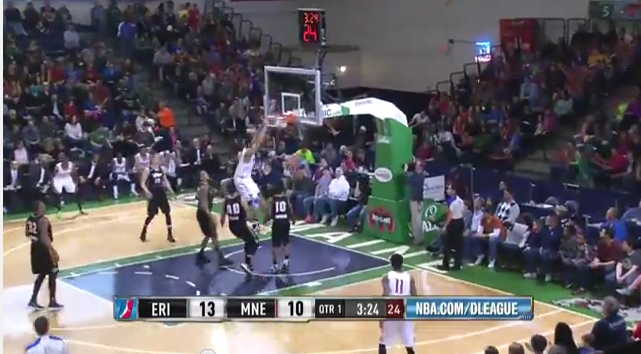
Defensively, the biggest problem with Melvin at times is he seemed to be hesitant in his decision making. Due to his position on the wing, he was often in flux in terms of when to help and when to stay on the wing on plays that involved the pick and roll or opponents driving or slashing to the rim. Take a look at this possession against the Maine Red Claws.


Melvin is on the left wing, slightly sagging off his man, seeing that the pick and roll is going to be run with Maine guard Abdul Gaddy and center Zeke Marshall. It is this kind of awareness that works in Melvin's favor. He knows the pick and roll is coming, and he knows it's going to attack in his direction. He is putting himself in good position to see how it develops, and react accordingly depending on what Gaddy and Marshall do.


As expected, Marshall rolls and is open after setting the pick. While a majority of the fault has to be placed on the two Erie defenders, it is important to pay attention to Melvin here. Right now, Melvin's hesitation prevents him from making a spectacular defensive play. He recognizes that Marshall is open on the roll, but he instead tries to play halfway respecting his man beyond the arc, and Marshall down low. If you watch the film, he kind of goes back and forth shuffling between the two unsure who to stay on. Instead of properly guarding either, he guards neither. Gaddy is able to thread the needle to Marshall (by Melvin who tries to contest the pass, but his hesitation leads to him whiffing on that) which results in the easy dunk as shown below.


His defensive ability will be a big factor in determining Melvin's future at the next level. He has improved his offensive skills to make himself able to score on all areas of the floor. But Melvin seems to lack motor in the more physical part of the game. He doesn't really have a killer instinct on the glass, and while he can make the spectacular block at times, he does show too much hesitation on the defensive end to have an impact. It is in these areas where Melvin profiles more like a poor-man's Anthony Randolph than Corey Brewer: Melvin has a lot of the tools and abilities to be successful, but his lack of energy and effort in areas other than scoring the basketball makes one wonder if Melvin will have much of a NBA career. Randolph can get away with it because he's 6'11 with freakish wing span. Melvin doesn't have those measurements, which makes his style of play less tolerable with NBA GMs and coaching staffs.

But, Melvin has developed a lot since his time at DePaul. DraftExpress in 2011 called him a "6'7 center non-prospect" and he has come a long way to show that he can be an effective small forward or small ball forward type. The positives of Melvin's game is that he doesn't force the issue offensively: he plays a polished kind of game where he lets his offense come to him. He's apt to set good ball screens and cuts well to the basket off those screens for easy buckets. Out of all the D-League "longshots" beyond PJ Hairston and Thanasis Antetokounmpo, Melvin has the best shot of getting drafted and making a NBA team because he's the most polished D-League eligible player available (other than the two listed above) and showed the most growth as a player since arriving as a freshman at DePaul. It'll be interesting to see if a team will see that and give him a chance, even if the rebounding and defensive energy and effort still need some work.

Tuesday, June 24, 2014

D-League NBA Draft Prospect: Norvel Pelle, PF/C, Delaware 87ers

Norvel Pelle (practicing with the USA National Developmental U17 team in 2010) is a long-term project hoping to get selected in the NBA Draft. Pelle played last season with Delaware in the D-League.


If you have been following these posts on "draft-eligible" prospects over the past week, you may be seeing a connection: all the ones so far have played for the Delaware 87ers. The Sevens, in their first year of existence in the D-League after being the Utah Flash for many years before (and thus an affiliate of the Utah Jazz), have taken a different approach in terms of assembling a D-League roster with signings ranging from college castoffs (Reeves Nelson, Elijah Pittman) to former high school phenoms (Aquille Carr) to more typical journeyman college players (Kendall Marshall, Matt Bouldin) to even siblings of NBA players (Thanasis Antetokounmpo). It hasn't resulted in a lot of on-court success for the franchise (the Sevens had the worst record in the D-League at 12-38), but it showed that the Sevens could function as a true "minor league" organization to their parent franchise (the Philadelphia 76ers).

And what does it mean to be a "minor league" organization? It means player development comes before on-court success. And no player may have benefited from that more than power forward/center Novel Pelle, who, much like fellow Sevens Antetokounmpo, Pittman and Carr, will be eligible to be selected in this upcoming NBA Draft.


Who is Norvel Pelle?

Out of Price High School in Long Beach, California, Pelle was one of the top center recruits in the nation for the class of 2011. According to ESPN.com, he was rated as the 12th best center prospect in the nation, and the 77th best prospect overall, and his size, athleticism and recruiting merits earned him a scholarship to St. John's in New York. And it's easy to see why he garnered such high praise and an offer from a Big East school. Pelle's long wingspan (he measured at 7'2.5 at the NBA Draft combine last year) helped make him a force in the paint on both ends of the floor. It was regular to see Pelle either at Price or on the AAU circuit either making spectacular blocks or finishing breathtaking alley oops. Take a look at a MixTape from 2010, which was compiled of AAU highlights of him in the summer entering junior year:


From the tape above, you can see why Steve Lavin was so eager to team him up with Moe Harkless at St. John's and why he has intrigued NBA scouts. But unfortunately for Pelle, off the court issues have seemed to haunt him since he left high school. Before he could play a game for the Red Storm, Pelle was declared ineligible by the NCAA (along with other St. John's commits JaKarr Sampson and Amir Garrett) and thus not allowed to enroll at St. John's in the Fall, according to Adam Zagoria of Zagsblog. While Sampson and Garrett eventually got eligible and joined St. John's at some point, Pelle re-committed to Iona, but still was ruled ineligible academically by the NCAA and thus unable to play for the Gaels in 2012-2013.


So how did Pelle get to the D-League?

After committing to two schools in two years and unable to play for either due to academic/personal reasons (Pelle claimed in an interview he didn't play last year for Iona because of his mother being in bad shape, according to an interview with DraftExpress), the center prospect decided to declare for the NBA draft. Pelle participated in the NBA Draft Combine and a couple of draft workouts before ultimately pulling his name out of the draft. One of the big rumors surrounding him leaving was that he still had a lot of maturing to do not just as a player, but as a person in general. Take a look at the interview portion of the DraftExpress video below and it is obvious that Pelle interviewed and presented himself like a kid just out of high school, not one ready to make the next step to the NBA.


Not ready for the NBA, Pelle didn't stay in the NBA Draft (he most likely would have gone undrafted if he stayed). Him and his agent looked to be headed to a club team overseas. but Pelle was drafted six overall in the NBA Developmental League Draft and he decided to sign with the team that drafted him, the Delaware 87ers.


How did Pelle do in the D-League?

Pelle's first professional campaign was a mixed bag of sorts. He averaged 5.5 points per game, 3.1 rebounds per game and 1.4 blocks per game on 13.5 minutes per game over the course of 35 games. Those numbers aren't impressive at first glance, and even his per 36 minute stats really don't impress at 15.3 ppg, 8.4 rpg and 3.9 bpg (also 8 fouls per game, as fouls were an issue in his first year). Most of Pelle's value comes from the defensive end, as evidenced by his good block rate in comparison to his team (21.5% team block rate). That being said, while the strongest part of his game is on the defensive end, he even still has a long way to go. Check out how some of his points in the paint numbers per 36 minutes compare to fellow post teammate Tiny Gallon:


As you can see, on a per 36-minute basis, Gallon proved to be a much better player not only offensively in the paint (16.8 to Pelle's 11.2 PITP), but defensively overall as well. Opponents scored less off turnovers (16.8 to Pelle's 18.5), less off the fast break (13.4 to 14.8) and less in the paint (40.5 to 41.1) against Gallon than Pelle. Considering Pelle is bigger, longer and more athletic than Gallon (though younger, so Gallon has the advantage in playing experience from his time at Oklahoma and in the D-League), it just goes to show that while Pelle has the athletic tools to be a NBA player, he is very early and raw in his development and his numbers showed that last season in Delaware.

While Pelle did battle some injury issues over the year, it was obvious that the time away from the game had an effect on Pelle in his first professional season. Going against players who not only have played college ball, but also some who have had considerable professional experience, Pelle struggled at times to adjust, and he looked hesitant and didn't look to be giving consistent effort at times while on the floor.

A key example of this is this change of possessions showed below in a late season game against Erie. On these two possessions, Pelle's lack of experience and consistent effort is evident. Let's take a look at the start of the offensive possession below:


BJ Young after a made Erie bucket tries to force the issue with a full court drive. Pelle is filling the lane with him, but his end positioning doesn't help Young. Instead of filling out into the corner or short corner, Pelle positions himself on the block. This shows his lack of playing experience in a couple of ways. First off, if he is in the corner or short corner, he puts his man on defense in a dilemma. If his man helps on D to contest the layup, Pelle will have that easy mid-range or corner 3 shot (most likely mid-range, since he hasn't showed much 3-point ability, as evidenced by his 0.1 3FGA this year). If Pelle's defender stay with him on the mid-range, then Young has an easier time getting the layup or foul. But, because Pelle doesn't drift to the short corner or corner, Pelle's defender has an easier time helping, and Young's shot is heavily contested. Young misses, Pelle, is blocked out by his defender (since he didn't have to commit much in order to help on defense) and Erie gets the ball on the break.


As they are on the break, notice how Pelle is the last guy coming back on defense. Yes, he was furthest underneath the hoop, but Pelle has the athletic gifts to cover a lot of floor with his athleticism and length. Instead, as you can tell from the shot above, he is jogging slowly back, which is putting pressure on the other three defenders knowing that Pelle is either going to come back late or not be there at all on defense. Which results in...


The easy layup for the Bayhawks. Pelle is just above the free throw line instead of in the post, and you can see No. 32 for the Sevens frustrated that no one picked him up. Well, no one picked him up because Pelle should have been there. If Pelle was hustling back, he could have gotten the block from the behind, or at the very least fouled him to prevent the easy bucket and make him earn it at the line. Instead, Pelle's lack of effort costs the Sevens on defense and leads to an easy Erie bucket.

But, growing pains like this are to be expected. Pelle made a major jump from high school ball to professional ball in a short period of time. And considering he was a player who relied on his athletic gifts to carry him during his high school years, its moments like these that can be teachable moments for Pelle going forward as a professional. That being said, when he's in position, Pelle is a strong post defender, as he does have good instincts and uses his length appropriately to block shots and defend the rim. Here's a possession where his defensive ability is used appropriately and helps his Sevens squad.


Pelle is fronting his man who his located slightly above the left block. Pelle notices that the Bayhawk guard has his man (Josh Akognon) beat. So, he sags a little toward the restricted area ready to help out on defense. This awareness showed by Pelle is solid. He's not showing too early (if he shows too early, he allows his defender to cut to the basket for the alley oop), but he's obviously aware and in the right position to help out on defense. Let's see what happens.


The Bayhawk guard drives for the layup and Pelle comes over and blocks his shot with ease. It is moments like this where Pelle excels as a player. He does have a natural gravitation toward the ball on defense, and he is able to block and defend shots in the paint with regularity. Even when you look at his highlight film below, it is his defense that stands out to you, and considering how hard it is to find good post defenders at the professional level, it is easy to see why and how Pelle could find a place at the next level.


Pelle certainly has the tools to be a NBA player, but not right now. He needs more professional experience, more court time and more development, and he would be better served working on those skills in the D-League or perhaps overseas (I think D-League is a better option for him though after his growth last season in Delaware). He lacks a go-to move and struggles to find his game and identity on the offensive end (he wavers too much from being a post player and being a perimeter player and thus, his skills are under-developed on both ends). Furthermore, his inconsistent effort on both sides of the ball is something he needs to work on if he ever wants to make that jump to the NBA. He can't afford to take plays off, especially over an extended 82-game schedule and the increased competition he'll face night in and night out.

But Pelle has the potential, and with some more time, he could develop into something special. His game seems to be a cross of Joel Embiid and DeAndre Jordan, though he doesn't have Embiid's footwork or Jordan's strength. That being said, with a little more development and time, he could end up matching that projection in some sort of way. His defensive abilities and instincts are already a plus (or at the very worst, near a plus), he just needs to round out the other parts of his game.

Monday, June 23, 2014

MixTape Monday: Theo Pinson, Tacko Fall and Dennis Smith, Jr.

Every monday, MLH will show MixTapes of some of the best high school/JuCo/International Youth players out there. This is to give you a glimpse on some of the best up and coming basketball players. Videos are courtesy of Ball is Life, HoopMixTape and Home Town Hoops. Definitely check out those sites for more MixTapes of the best players coming up the ranks.


Theo Pinson, 6'6, 190 pounds, Wesleyan Christian Academy of Greensboro, North Carolina, Signed with North Carolina

A McDonald's All-American and Jordan Brand Classic participant, Pinson is an explosive guard that will stay home in-state and be expected to contribute immediately for Roy Williams at North Carolina. Pinson is the 10th best prospect according to ESPN, and the 3rd best guard prospect as well. After struggling to find consistent talent in the past five years, Williams seems to have a player that could not only have impact, but live up to his considerable hype.

Pinson is an athletic, tall guard who offers a variety of skills. He displays a strong ability to get to the basket and can finish in a variety of ways. While he can thunder it down, I chose the "non-dunking" MixTape to display his multiple abilities as a guard. He can finish in traffic extremely well, either by layup or the pull up jumper. Furthermore, he shows good vision and passing ability in traffic as well, as Pinson on a consistent basis was able to find cutting teammates for easy layups and alley-oops. What also strikes you about Pinson's game is his intensity. He's a strong competitor who plays hard on both ends, and that is a trait that will cater well to Williams' intense style of coaching. The Tar Heels will be losing some key cogs to the draft this Thursday (James Mcadoo and PJ Hairston, who was ineligible last season), but Pinson looks like he can soften the losses for Williams and keep this Tar Heels competitive once again in the ACC.


Tacko Fall, 7'5, 270 pounds, Liberty Country High School of Taveras, Florida, Undecided

Nicknamed "Taco" because of his first name, Fall is one of the most intriguing senior-to-be prospects in the nation. At 7'5, he would be the tallest NBA player if he entered the draft today, and he has been a bit of a highlight reel player that has packed venues wherever he has played so far.

Fall is still a bit raw as a prospect, as he doesn't crack the ESPN 100 and is only rated as 18th best center prospect according to ESPN. Originally from Senegal, Fall has only been playing basketball since arriving in the United States, and he has experienced a lot of ups and downs in his development as a player. He doesn't really have much of a motor, and his footwork still needs a lot of work, as he is prone to shuffle his feet at times when receiving the ball down low in the post. However, Fall utilizes his height well and uses his size and strength to overpower opponents not only on the offensive end, but defensively as well. As of now, his game is very similar to Hasheem Thabeet, but only a senior-to-be, it is possible that Fall will continue to develop his game and skills to hopefully surpass that projection. Fall is undecided now, but apparently has offers already from LaSalle and Xavier, and is also looking at Baylor, Houston and Princeton.


Dennis Smith, Jr, 6'2 180 pounds, Trinity Christian School of Fayetteville, NC, Undecided

Smith is only going to be a junior next season, but that hasn't stopped him from making waves as one of the best guard prospects in the nation currently. Smith can wow people with exceptional ball handling skills and explosive athleticism. For a guard, he can easily cut through the defense and finish at the rim with exceptional dunks and layups on a consistent basis. One of the strongest aspects of his game is his explosion off the hesitation dribble, as he routinely made minced meat of opposing perimeter defenders with the move which led to either easy dunks or points for Smith, or assists to teammates for effortless buckets.

Smith is rated as the No. 1 point guard prospect and 6th best prospect overall in the Top 247 according to 247 Sports. He apparently is strongly considering to commit to Duke, as evidenced by 10 of 12 of the recruiting experts polled on 247 sports listing Duke as his college landing spot. The decision by Smith would be a solid one, as Coach K has a reputation of developing strong point guards such as Bobby Hurley, Jay Williams, Nolan Smith and most recently, Kyrie Irving. Smith is someone to be paid attention to, especially since he has two years left of high school eligibility.

Saturday, June 21, 2014

D-League Top-15 Prospect List: Honorable Mentions

Ron Howard (left) and Frank Gaines are two heralded D-League prospects who just missed the initial Top-15 cut


Before we start going into profiles of the Top-15 prospects, it is important to look at some D-League players who missed the cut due to a variety of reasons. D-League basketball (much like Minor League baseball) is really used for two reasons: 1.) to help develop talent in preparation for the highest level of play or 2.) house guys who aren't quite good enough to make the NBA. While early on in the D-League's existence it was used more for the latter, the D-League has developed as a league to where it's no longer seen as a "death sentence" as almost 33% of D-League players last season saw some kind of call up to the NBA.

Of course, as a "prospect" blog of sorts, the big question is who should NBA fans paying attention to in the D-League? Who is showing promise? And who is on the cusp of being that D-League star that shines in the NBA? (Jeremy Lin, Danny Green, Patty Mills and Gerald Green are all recent examples). Well, that is what the Top-15 list is for: to serve as a ranking of who in MLH's mind is on the cusp of making a NBA roster and possibly breaking out with the right opportunity and situations.

That being said, with 18 teams starting in the 2014-2015 season (the Westchester Knicks will join the fold in November 2014), coming up with the best, most promising 15 players on the prospect list isn't easy. A lot of considerations have to be taken to see who is a "true prospect" and who is just holding a spot down between the D-League and another league internationally. So, here are a list of some guys who just missed the cut.


The NBA Draft Eligible Prospects

  • PJ Hairston, G, Texas Legends
  • Thanasis Antetokounmpo, G/F, Delaware 87ers
  • Aquille Carr, G, Delaware 87ers
  • Cleveland Melvin, F, Erie Bayhawks
  • Norvel Pelle, F, Delaware 87ers
  • Elijah Pittman, F, Delaware 87ers

Because these guys are eligible for the draft, the six above did not make it into the ratings. To be honest, if I could consider them, I would have, since they are all very promising players. That being said, with the draft less than a week away, I wanted to see how the draft and summer league panned out first before I put them into consideration. Some of these guys may be in the NBA by next Fall (most likely Hairston, a potential first round pick, and Antetokounmpo, a late first, early second-round pick), while some may opt to go overseas. So, while these are good players, their draft-eligible status keeps me from considering them into the Top-15 as of this moment.


The "Too Old" Guys
  • Shawne Williams, F, Los Angeles D-Fenders
  • Ike Diogu, F, Bakersfield Jam
  • Craig Smith, F, Sioux Falls Skyforce
  • Sundiata Gaines, G, Reno Bighorns
  • Dominic McGuire, F, Tulsa 66ers
  • Mustafa Shakur, G, Tulsa 66ers
  • Ron Howard, G, Fort Wayne Mad Ants

Some of these players are on the cusp of making a roster in the NBA, but they pass the "over 5 years a professional" limit. And, a lot of these guys don't have much upside left as some have had a decent amount of time in the NBA already, and would most likely be an end of the bench guy if called up (Williams, Diogu and Smith being the prime examples). That isn't to say I don't like some of these players, and they should definitely be kept an eye on. But they're too far in their professional basketball careers to be considered true "prospects".


Guys who just missed the cut
  • Shane Edwards, F, Canton Charge
  • Frank Gaines, G, Maine Red Claws
  • Dequan Jones, F, Reno Bighorns
  • CJ Williams, G, Los Angeles D-Fenders
  • Trey McKinney Jones, F, Fort Wayne Mad Ants
  • Mario Little, G, Tulsa 66ers
  • Scott Suggs, G, Erie BayHawks

For these guys, it was hard to omit some of them, as some of them listed did earn call-ups at some point in the year. These guys were left off the Top-15 cut for a variety of reasons. Some are still raw and developing their game (Little, Edwards). Some have put up great numbers, but I need to see more time to make a more sound judgment on them (Gaines, Williams, McKinney Jones).  And some underwhelmed in college or early on, have turned it on a bit, but still have some more development to go before they can be considered "true" prospects (Suggs, Jones). All these guys are definitely capable and on the radar of making the Top-15 in the future, especially once the D-League starts.


So those are the honorable mentions. Check out the Top-15 page for updates to the list over the course of the summer and D-League season. Also, the official D-League Prospect Watch is a good place to see what players are considered the D-League's Top-30 prospects, though their rankings differ from MLH (they don't put the age stipulation like I do).

Thursday, June 19, 2014

A Primer to the Top-15 D-League Prospect Rankings

Starting tomorrow, I'm going to be doing the countdown for the Top-15 D-League Prospect rankings going into the 2014-2015 season. Of course, this list is going to fluctuate constantly. With guys getting called up and demoted down on a regular basis, players may be in the Top-15 one week, and then may disappear altogether the following week. So, the Top-15 D-League Prospect rankings are something one should keep close attention to, as it will be a weekly update, especially as the D-League season begins.

I will be listing some honorable mentions tomorrow, and then either over the weekend or on Monday, I'll be starting with No. 15 on the prospect countdown. I formulate my rankings on a variety of things, from the NBA D-League's official "Prospect Watch" to Ridiculous Upside's "Prospect Pyramid". However, in order to really gauge the word "prospect", I am modifying my criteria for the rankings in comparison to some of the other D-League rankings out there on the Web.

The big one is the "years pro" cap I put on potential "prospects". From my experience covering Minor League baseball, there is a difference between someone that is a "prospect" and someone that is just a "minor league player" (or 4A players as they call it in baseball). A guy may be dominant in the D-League, but if he has been around professional basketball for a long time, then dominating less-competitive talent is not as impressive in comparison to a first-year professional dominating the D-League. So, I take that more into consideration, and a younger guy with slightly lower numbers than a veteran will get the benefit of the doubt in my rankings.

Also, I am eliminating players who have played more than 5 years professionally from the rankings (so six and up). Anybody who has been playing that long professionally should have found a spot in the league at this point, so I don't think there's any upside to them playing in the D-League. They may be dominating and putting up numbers, but they should have at that point found a niche on a NBA roster if they were that good. It's kind of like the "Age 26" rule in minor league baseball: at age 26, a player is what he is. The same holds true for basketball prospects in my mind. At year six, they most likely are what they are as a player, and if they are in the D-League, their career upside is probably the D-League, International ball or a couple of 10-day contracts here and there.

So, eliminated are guys like Craig Smith, Sundiata Gaines, Shawne Williams, Ike Diogu and Dominic Mcguire. I think it's safe to say those guys are in the D-League not because they need a little more seasoning or more playing time, but they're just outside the bubble in terms of being a regular NBA player. Even if they do make it to the league, there just isn't a lot of upside left for those guys, who have been playing professional ball for a long time.

That is the main criteria for the rankings: younger guys will get more consideration than older players (upside over straight performance) and players with six or more years of professional experience are eliminated from the rankings.

Honorable mentions will be listed tomorrow. Let the countdown begin!

Wednesday, June 18, 2014

Coverage of 2014 NBA D-League Tryout

Keith Schlosser of Ridiculous Upside had a good writeup about the Top Standouts at Sunday's 2014 NBA D-League tryouts in New York City. Schlosser profiled six players at the tryout, but I am going to focus on going more in-depth about three of the players he wrote up about. A very good read, and a good introspective on the NBA D-League Tryout, which according to Schlosser, had over 200 players in attendance and many promising coaches as well.


Adam Kemp, 6-10 forward, Marist College


Here is what Schlosser said about Kemp at the tryout on Sunday:

"Despite having displayed a solid offensive game on the collegiate level as well, Kemp looked like a man amongst boys by stepping in as an intimating defensive presence. He could undoubtedly find a spot on the minor league level, because big bodies are always useful. Luckily for Kemp, he comes with a capable skill-set as well."

Kemp has just recently graduated from Marist, a team that went 12-19 and finished in the middle of the pack of the Metro Atlantic Athletic Conference this past season. As a player, Kemp bloomed a bit late, as he was pretty below average his first season with the Red Foxes, putting up an offensive rating of 89.4. He improved his rating though each year, and finished his senior campaign with a 103.4 offensive rating, helped by 13.1 percent offensive rebounding rate, which was 62nd best in the nation. In terms of his average stats, Kemp averaged 10.1 ppg and 7.6 rpg his senior season.

Defensively, Kemp also adds some value as a shot blocker, as his 7.8 percent block rate was rated in the top 100 in the nation according to Ken Pom. Marist was in the lower end of the conference when it came to block percentage (they ranked 9th in conference play), so Kemp did not have a lot of help defensively in the post. (Which also makes sense when you look at their effective height rating, which was below average according to Ken Pom at -0.4)

When you watch Kemp on tape, he's strong and shows good footwork and athleticism in the post. The assumption when you first look at him may be that he's kind of just a banger, but he shows a strong ability to block shots without fouling, and he has the saavy and footwork to get easy dunks and buckets when he's in traffic around the rim. That being said, his game is mostly centered around the paint, as I have not seen him test his game much with the mid-range or 3-point shot.

Overall, Kemp might have a career in the D-League as a Mason Plumlee-like player, though he certainly doesn't have Plumlee's size or physicality. But it's entirely possible to see Kemp be a second or third post option for a D-League team, and a seventh-eighth man type that can give a lot of stability to a team. While he has steadily improved as a player in college, I don't know if he'll progress much at the professional level, but he certainly has the skills to make a D-League team, and his stats look better when you consider that the MAAC was a much better mid-major conference than people would like to think (ranked 13th best in the nation last year according to Ken Pom, better than Conference USA, MAC and CAA).


Justin Simmons, 6-3 guard, Nebraska-Omaha


Simmons may have been the most interesting player to attend the camp, according to Schlosser. Here is what he said about the recently graduated guard in his writeup:

"Just weeks removed from completing his collegiate career, it's safe to say Simmons could have the most potential out anyone in the entire group. A naturally gifted high-flying guard, the young gun has eye-popping athleticism. He runs the floor well, can handle the ball even better, and knows how to finish at the hole. He's not afraid of taking it inside against taller defenders."

If you watch the highlight video above, it's easy to see why one can get excited about Simmons. Physically, he can jump, dunk with authority and his athleticism for his size is quite evident. Whether it was him dunking solo or in-game, its obvious that that Simmons brings a lot of potential to D-League and professional scouts.

But this year was a step back for the D-League prospect. A JuCo transfer from Butler Community College, where he averaged 16.8 points per game and shot 49 percent from the field in his lone season at at BCC, Simmons was a second-team All-Summit player his junior year, when he averaged 16.7 points per game, shot 40.2 percent from the field, and started 30 games for the Mavericks. But as a senior year, his playing time fluctuated, and his ppg average dropped to 10.2 ppg, and he only shot 36.9 percent from the field. It seemed like injury problems did him in during his senior campaign, as he only started 17 games because of injuries (though he did appear in 30). That being said, Simmons finished his career strong, as he scored 14 points in their final CIT game against Murray State, and he finished second in the State Farm Dark Horse Dunker contest.

In terms of efficiency, Simmons seems to be below average on the offensive end. His 90.5 offensive rating according to Ken Pom was a vast regressions from his 99.3 rating a year ago (though that junior year rating is still below average). He also struggled from beyond the 3-point arc his senior season, as he took roughly the same amount of shots beyond the arc, but made far less (dropped from 40.2 to 25.2 percent). If Simmons is going to have a professional career, he has to find a medium in between with his shooting and it'll be interesting to see how he progresses. Was last year just an outlier caused by injury (46.3 percent TS)? Or was his junior year a peak for his shooting ability (55.7 TS percentage junior year). It'll be interesting to see, but with his athleticism, it is possible that Simmons may be given a shot at the D-league level to prove that his injuries are behind him and that he can play back to his junior year form.


Naofall Folahan, 6-11 center, Wagner


Folahan probably has the best shot to make an NBA Summer League team this summer thanks to his size, length and athleticism. Schlosser echoed a lot of these things in his writeup about the big man from Benin:

"Folahan's incredible athleticism on both ends of the floor is second to none. He has natural ability, quite similar to the professional athletes already gracing D-League and even some NBA stages...Such capabilities should help Folahan emerge as a shoe-in for selection come D-League Draft time, but his beautiful potential could also be enough to garner consideration from an NBA team or two heading into Summer League."

From all the guys Schlosser wrote about, Folahan is the one I will most eagerly keeping an eye on this summer. When you watch him on tape, he really has a lot of potential, and he is strong defensively, which could carry him at the professional level as somewhat of a poor man's Desagna Diop. He was a stout defensive presence for Wagner last year, as his 14.2 block percentage was 6th best in the nation. Furthermore, he shows good instincts and presence in the post, as he doesn't always go for blocked shots, and is able to force defenders to make tough shots around him, which leads to defensive rebounds and change of possessions. It was obvious that he was a project when he first came to Wagner, but he has developed a lot as a player, and his ability and skills on defense are what jumps out to you immediately.

But, his offensive game is very unrefined, and raw. He was not much of a presence at all in his time at Wagner on the offensive end, as his usage rate was low last year at 11.4 percent. While his offensive rating at 104.9 in his senior year was a step up from his junior campaign (96.9), it still paled in comparison to his sophomore rating of 116.5. Granted, he did achieve his 104.9 rating with more minutes, but Folahan just struggles to put the ball in the hoop consistently. After putting up a true shooting percentage of 61.6 his sophomore year, it dipped dramatically to 52.6 percent his senior year, alarming considering his usage rate was higher his sophomore season (13.1 percent). Folahan remains mostly a block kind of player, as his game rarely ranges outside the paint. It is similar to what you would see from Samuel Dalembert, raw and unrefined, and mostly scoring thanks to the creation made by his teammates (i.e. dump passes off the drive) or himself (off of offensive boards). But unlike Dalembert, he isn't as proficient on the offensive glass for a man his size (9.7 percent) and he isn't quite a strong either.

It is obvious that Folahan will be a project for any D-League team that picks him up. And after being in college for four years, some teams may not be as patient with him due to his age and stage of development. That being said, his size, defensive ability and potential could be worthwhile for any team and organization that is willing to be patient with him. He could break out in a couple of years for any D-League or professional squad if he makes any progress on the offensive end.