Showing posts with label Delaware 87ers. Show all posts

Tuesday, June 24, 2014

D-League NBA Draft Prospect: Norvel Pelle, PF/C, Delaware 87ers

Norvel Pelle (practicing with the USA National Developmental U17 team in 2010) is a long-term project hoping to get selected in the NBA Draft. Pelle played last season with Delaware in the D-League.


If you have been following these posts on "draft-eligible" prospects over the past week, you may be seeing a connection: all the ones so far have played for the Delaware 87ers. The Sevens, in their first year of existence in the D-League after being the Utah Flash for many years before (and thus an affiliate of the Utah Jazz), have taken a different approach in terms of assembling a D-League roster with signings ranging from college castoffs (Reeves Nelson, Elijah Pittman) to former high school phenoms (Aquille Carr) to more typical journeyman college players (Kendall Marshall, Matt Bouldin) to even siblings of NBA players (Thanasis Antetokounmpo). It hasn't resulted in a lot of on-court success for the franchise (the Sevens had the worst record in the D-League at 12-38), but it showed that the Sevens could function as a true "minor league" organization to their parent franchise (the Philadelphia 76ers).

And what does it mean to be a "minor league" organization? It means player development comes before on-court success. And no player may have benefited from that more than power forward/center Novel Pelle, who, much like fellow Sevens Antetokounmpo, Pittman and Carr, will be eligible to be selected in this upcoming NBA Draft.


Who is Norvel Pelle?

Out of Price High School in Long Beach, California, Pelle was one of the top center recruits in the nation for the class of 2011. According to ESPN.com, he was rated as the 12th best center prospect in the nation, and the 77th best prospect overall, and his size, athleticism and recruiting merits earned him a scholarship to St. John's in New York. And it's easy to see why he garnered such high praise and an offer from a Big East school. Pelle's long wingspan (he measured at 7'2.5 at the NBA Draft combine last year) helped make him a force in the paint on both ends of the floor. It was regular to see Pelle either at Price or on the AAU circuit either making spectacular blocks or finishing breathtaking alley oops. Take a look at a MixTape from 2010, which was compiled of AAU highlights of him in the summer entering junior year:


From the tape above, you can see why Steve Lavin was so eager to team him up with Moe Harkless at St. John's and why he has intrigued NBA scouts. But unfortunately for Pelle, off the court issues have seemed to haunt him since he left high school. Before he could play a game for the Red Storm, Pelle was declared ineligible by the NCAA (along with other St. John's commits JaKarr Sampson and Amir Garrett) and thus not allowed to enroll at St. John's in the Fall, according to Adam Zagoria of Zagsblog. While Sampson and Garrett eventually got eligible and joined St. John's at some point, Pelle re-committed to Iona, but still was ruled ineligible academically by the NCAA and thus unable to play for the Gaels in 2012-2013.


So how did Pelle get to the D-League?

After committing to two schools in two years and unable to play for either due to academic/personal reasons (Pelle claimed in an interview he didn't play last year for Iona because of his mother being in bad shape, according to an interview with DraftExpress), the center prospect decided to declare for the NBA draft. Pelle participated in the NBA Draft Combine and a couple of draft workouts before ultimately pulling his name out of the draft. One of the big rumors surrounding him leaving was that he still had a lot of maturing to do not just as a player, but as a person in general. Take a look at the interview portion of the DraftExpress video below and it is obvious that Pelle interviewed and presented himself like a kid just out of high school, not one ready to make the next step to the NBA.


Not ready for the NBA, Pelle didn't stay in the NBA Draft (he most likely would have gone undrafted if he stayed). Him and his agent looked to be headed to a club team overseas. but Pelle was drafted six overall in the NBA Developmental League Draft and he decided to sign with the team that drafted him, the Delaware 87ers.


How did Pelle do in the D-League?

Pelle's first professional campaign was a mixed bag of sorts. He averaged 5.5 points per game, 3.1 rebounds per game and 1.4 blocks per game on 13.5 minutes per game over the course of 35 games. Those numbers aren't impressive at first glance, and even his per 36 minute stats really don't impress at 15.3 ppg, 8.4 rpg and 3.9 bpg (also 8 fouls per game, as fouls were an issue in his first year). Most of Pelle's value comes from the defensive end, as evidenced by his good block rate in comparison to his team (21.5% team block rate). That being said, while the strongest part of his game is on the defensive end, he even still has a long way to go. Check out how some of his points in the paint numbers per 36 minutes compare to fellow post teammate Tiny Gallon:


As you can see, on a per 36-minute basis, Gallon proved to be a much better player not only offensively in the paint (16.8 to Pelle's 11.2 PITP), but defensively overall as well. Opponents scored less off turnovers (16.8 to Pelle's 18.5), less off the fast break (13.4 to 14.8) and less in the paint (40.5 to 41.1) against Gallon than Pelle. Considering Pelle is bigger, longer and more athletic than Gallon (though younger, so Gallon has the advantage in playing experience from his time at Oklahoma and in the D-League), it just goes to show that while Pelle has the athletic tools to be a NBA player, he is very early and raw in his development and his numbers showed that last season in Delaware.

While Pelle did battle some injury issues over the year, it was obvious that the time away from the game had an effect on Pelle in his first professional season. Going against players who not only have played college ball, but also some who have had considerable professional experience, Pelle struggled at times to adjust, and he looked hesitant and didn't look to be giving consistent effort at times while on the floor.

A key example of this is this change of possessions showed below in a late season game against Erie. On these two possessions, Pelle's lack of experience and consistent effort is evident. Let's take a look at the start of the offensive possession below:


BJ Young after a made Erie bucket tries to force the issue with a full court drive. Pelle is filling the lane with him, but his end positioning doesn't help Young. Instead of filling out into the corner or short corner, Pelle positions himself on the block. This shows his lack of playing experience in a couple of ways. First off, if he is in the corner or short corner, he puts his man on defense in a dilemma. If his man helps on D to contest the layup, Pelle will have that easy mid-range or corner 3 shot (most likely mid-range, since he hasn't showed much 3-point ability, as evidenced by his 0.1 3FGA this year). If Pelle's defender stay with him on the mid-range, then Young has an easier time getting the layup or foul. But, because Pelle doesn't drift to the short corner or corner, Pelle's defender has an easier time helping, and Young's shot is heavily contested. Young misses, Pelle, is blocked out by his defender (since he didn't have to commit much in order to help on defense) and Erie gets the ball on the break.


As they are on the break, notice how Pelle is the last guy coming back on defense. Yes, he was furthest underneath the hoop, but Pelle has the athletic gifts to cover a lot of floor with his athleticism and length. Instead, as you can tell from the shot above, he is jogging slowly back, which is putting pressure on the other three defenders knowing that Pelle is either going to come back late or not be there at all on defense. Which results in...


The easy layup for the Bayhawks. Pelle is just above the free throw line instead of in the post, and you can see No. 32 for the Sevens frustrated that no one picked him up. Well, no one picked him up because Pelle should have been there. If Pelle was hustling back, he could have gotten the block from the behind, or at the very least fouled him to prevent the easy bucket and make him earn it at the line. Instead, Pelle's lack of effort costs the Sevens on defense and leads to an easy Erie bucket.

But, growing pains like this are to be expected. Pelle made a major jump from high school ball to professional ball in a short period of time. And considering he was a player who relied on his athletic gifts to carry him during his high school years, its moments like these that can be teachable moments for Pelle going forward as a professional. That being said, when he's in position, Pelle is a strong post defender, as he does have good instincts and uses his length appropriately to block shots and defend the rim. Here's a possession where his defensive ability is used appropriately and helps his Sevens squad.


Pelle is fronting his man who his located slightly above the left block. Pelle notices that the Bayhawk guard has his man (Josh Akognon) beat. So, he sags a little toward the restricted area ready to help out on defense. This awareness showed by Pelle is solid. He's not showing too early (if he shows too early, he allows his defender to cut to the basket for the alley oop), but he's obviously aware and in the right position to help out on defense. Let's see what happens.


The Bayhawk guard drives for the layup and Pelle comes over and blocks his shot with ease. It is moments like this where Pelle excels as a player. He does have a natural gravitation toward the ball on defense, and he is able to block and defend shots in the paint with regularity. Even when you look at his highlight film below, it is his defense that stands out to you, and considering how hard it is to find good post defenders at the professional level, it is easy to see why and how Pelle could find a place at the next level.


Pelle certainly has the tools to be a NBA player, but not right now. He needs more professional experience, more court time and more development, and he would be better served working on those skills in the D-League or perhaps overseas (I think D-League is a better option for him though after his growth last season in Delaware). He lacks a go-to move and struggles to find his game and identity on the offensive end (he wavers too much from being a post player and being a perimeter player and thus, his skills are under-developed on both ends). Furthermore, his inconsistent effort on both sides of the ball is something he needs to work on if he ever wants to make that jump to the NBA. He can't afford to take plays off, especially over an extended 82-game schedule and the increased competition he'll face night in and night out.

But Pelle has the potential, and with some more time, he could develop into something special. His game seems to be a cross of Joel Embiid and DeAndre Jordan, though he doesn't have Embiid's footwork or Jordan's strength. That being said, with a little more development and time, he could end up matching that projection in some sort of way. His defensive abilities and instincts are already a plus (or at the very worst, near a plus), he just needs to round out the other parts of his game.

Sunday, June 22, 2014

D-League NBA Draft Prospect: Elijah Pittman, G/F, Delaware 87ers

After a rocky collegiate career, Elijah Pittman held his own in a limited stint in the D-League and is hoping to get a call on Draft night.


After covering Aquille Carr, Minor League Hoops will take a look at another enigmatic player eligible for the NBA Draft who ironically played at Delaware this past season in a limited stint much like Carr. Wing player Elijah Pittman, similar to Carr, is probably on the outside looking in coming into this draft, but he does offer enticing skills, athleticism and tools as a player. Let's take a deeper look into Pittman, how he fared in the D-League, and what his outlook will be for the NBA Draft and beyond.


Who is Elijah Pittman?


Pittman is a physical specimen that has attracted all coaches at all levels in his playing days. At 6'9, 210 pounds, Pittman has shooting ability to play both guard and forward on the wing, and though his dribbling isn't the strongest aspect of his game, it is good enough to merit playing time at the shooting guard position.

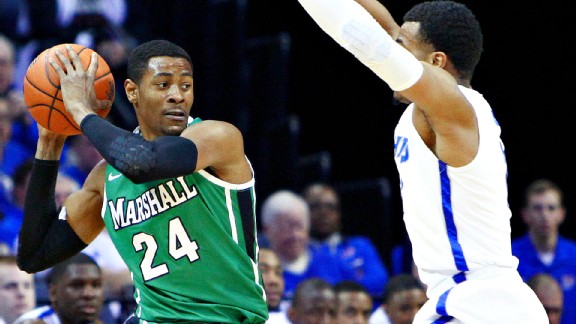
While his physical skills have never been in question, it's Pittman's maturity and questionable decision making that has held him back as a player. In junior college, he was dismissed from the Chipola Junior College in Texas in April due to multiple arrests. In October of his first season at Marshall University in 2012, he was involved in an altercation with a male Marshall student where Pittman faced misdemeanor battery charges (he later made a plea agreement). After eight games at Marshall his senior season (last year), the Thundering Herd suspended him indefinitely and he decided to leave the team after the suspension to pursue a professional career (more on that below). Off the court, Pittman hasn't done much right.

But on the court, Pittman has produced, especially at Marshall. His junior year was extremely promising as evidenced by his comprehensive stats courtesy of DraftExpress. Take a look at his per 40 stats in his two seasons with Marshall:


And then take a look at his efficiency stats in his first year at Marshall:


In his junior year, Pittman produced a PER (player efficiency rating) of 20.1. In the 8-game sample his senior year, he was on his way to surpass that with a 26.6 PER. His usage rate increased from 22.6 his junior year to 32.2 his senior year, and it was obvious that Pittman was turning into a reliable, go-to-guy for the Herd. He had three 30-plus scoring games in his eight game sample his senior year before his suspension, though they did come against pretty inferior competition (South Carolina State, Morehead State and UNC Wilmington). But regardless of competition, it is interesting to see if Pittman could have turned into a premiere player in the Conference USA judging by his impact and usage his senior season with the Herd.


So how did Pittman get to the D-League?

After Pittman was suspended, it seemed like Pittman had run out of chances at the collegiate level. Considering his past legal and off-the-court issues, it seemed very unlikely he was going to get back with the team and transferring didn't seem like an option for it was unlikely he was going to get another chance with another college, let alone another Division 1 school. So, much like Glen Rice Jr. the year before (who was dismissed from Georgia Tech), Pittman left Marshall and decided to go the D-League route to prepare for the NBA Draft.

In a good profile with Mid-Major Madness, Pittman acknowledged his mistakes and vowed that he has changed for the better. Here are some comments about the changes he made personally in his life and his drive in preparation for the draft:

"I’ve spent a lot of time handing out food for the homeless," said Pittman. "I also helped administer used clothes to the homeless with Kroger grocery stores. But other than that, I eat, sleep and drink basketball. I want coaches to know that I’m as hard working and humble as anyone else. I want an opportunity in the NBA more than anything, and to prove people wrong and that I am cut out for this."

The 87ers, who have been more than willing to take a flier on guys with checkered histories (see Carr and Norvel Pelle), ended up signing Pittman, hoping that his new outlook and the experience from the problems had changed him for good. Though he only played 10 games and averaged 20.6 minutes per game, Pittman stayed out of the media when it came to off-the-court issues, which is a success for him considering how bad his reputation was prior to signing with Delaware.


So how did Pittman do in the D-League?

Pittman didn't replicate his college production, but that was to be expected. The 22-year-old wing was a late addition, and considering how poor Delaware played this season (they finished 12-38), I'm sure trying to fit into the 87er squad wasn't an easy endeavor. The lack of experience with the team and his struggle to find a rhythm at a much higher level of play had the most effect on his efficiency, as his PER dipped to 12.7 and his TS % hovered around 54% according to DraftExpress, and his PIE (Player Impact) was 5.8%, according to the D-League stats page.

But considering his experience and his late exposure to the team, Pittman certainly held his own. He averaged 10 points per game and 3.6 rebounds per game in the 10 game sample and continued to show many of the skills that made him such an enticing prospect. For starters, Pittman's outside shooting carried over at the D-League level in some regards, as he proved to be a solid catch and shoot player. 66.7 percent of his 3 point shots came unassisted, and 33.8% of his points came from beyond the arc in his time with the 87ers. Pittman shows good shot form, with a high arc and clean release, and with his size, it makes it difficult for smaller wing or perimeter players to contest it. Let's take a look at Pittman's shot chart for the year, and pay specific attention to where he made most of his 3-point shots:


Pittman proved to be very efficient from the corner, especially from the right side. Considering how NBA teams like to spread the ball around and find those shooters in the corner for the 3 (heck, just look at the Spurs and Heat), Pittman could prove himself to be valuable to many different NBA squads. How he progresses with this outside shot and dependable he can be with it could be the difference from him finding a spot in a NBA rotation or being a Minor League lifer who spends a majority of his professional career in the D-League or overseas.

Though his outside shooting has garnered a lot of praise, Pittman has also showed a strong ability to dribble drive and finish around the rim. Here's a possession in a D-League game where he recognizes the advantage in the matchup and finishes successfully around the rim.


Pittman (located in the right wing around the score ticker) makes a good crossover move on the wing defender, recognizing the space open in his area, which is prime for him to dribble drive into. The BayHawks are throwing some kind of zone look with the post defender manning the middle sagging heavily off his man at the top. From here, it really depends on Pittman's skills and athleticism in terms of how this possession will finish. If he is athletic and strong in his drive, he'll get the bucket or fouled. If he isn't, it could result in a turnover or blocked shot.

Let's see how it finishes:


He successfully drives by the wing defender and as expected, the post defender helps and picks him up. Pittman however continues to attack, seeing the middle of the lane open and knows to be aggressive. At his size, he can hold his own with both post defenders (look at the other defender lurking on the left block), but he has the athleticism and speed to drive by them as well. Which results in ...


This excellent finish at the rim. Not only does he get by the slower post defender, but Pittman sidesteps and finishes on the right side, knowing that the help is coming from the left block. And thus, the post defender on the right block can't defend it because he can't match his athleticism, and the right block defender just is too late in terms of helping, unable to defend due to Pittman's adjustment. It's this kind of ability to recognize the defense and finish appropriately that makes Pittman a special player. And if you look at the shot chart above, Pittman was very reliable around the rim, as he was above league average at 63.3 percent. Check out the highlight video below and you'll see Pittman doing much of the same things on tape.


If Pittman has any weaknesses, it may be the fact that his game isn't very diverse beyond scoring. He isn't as strong a rebounder as you would imagine considering his size. He only averaged 0.9 offensive rebounds per game with Delaware, and his rate was 5.1 percent his junior season as well (5.0 percent in the smaller senior season sample). In order to take advantage of his size and ability to score around the rim, he has to be more active in terms of getting loose balls and second chance points (only 1.9 second chance points average last year). Also, defensively, while he has the length and size to affect opposing wing players, he doesn't show as much commitment or consistent energy on the defensive end of the ball. While that is something that can improve (after all, he has the natural gifts to be a better defensive player), it is something he needs to be aware of going forward if he wants to stick on a NBA roster.

While Carr may be a genuine longshot, Pittman has more of a punchers chance to get selected in the second round. While the odds are long, it is obvious he has the skills, size and athleticism to compete for a NBA roster spot. He showed immense promise not only in his time at Marshall, but in his short stint with Delaware, especially when you consider the situation he was going into (late in the year, losing team, etc.). Of course, his off court issues will definitely hurt him in this draft, and could be one of the big reasons why he could go undrafted next Thursday. Fellow Thundering Herd alum Hassan Whiteside had many similar "character issues" despite being a first round talent, and those issues eventually led to him being out of the league and bouncing from overseas team to overseas team currently (he was recently released by a Lebanese professional team) despite his skills and size. I think Pittman is a lot more mature than Whiteside was entering the draft (after all, Pittman has experienced a lot more "consequences" in comparison to Whiteside), but it wouldn't be surprising to see NBA front office members hold the Whiteside flame out against him due to them both being from Marshall and both having a history of character issues. It may be unfair, but that's kind of how things go when it comes to evaluating players to draft sometimes.

Whether he is drafted or not (my guess is no), it'll be interesting to see his progression next year as a full-time professional. Even if he makes it back to the D-League next year, he certainly is the kind of player who could make an impact with a D-League team immediately. And, starting the year with the squad would help him a lot more in terms of finding his role, and thus improve his stock and reputation even more in terms of making a NBA roster. It would not be surprising at all if we are hearing about Pittman again some point next December or January, eligible for a callup and 10-day contract.

Friday, June 20, 2014

D-League NBA Draft Prospect: Delaware 87er Guard Aquille Carr

Though Aquille Carr is a legend in high school and streetball circles, he has yet to put it together at the professional level leading up to 2014 NBA Draft.


With the NBA Draft less than a week away, there are many stories circulating around the Web from Joel Embiid's recent foot injury to what the Cavs are going to do with the No. 1 pick (at least they have chosen their coach though, more on this story over the weekend). However, one of the biggest stories going under the radar is the fact that six players who played in the D-League this season are eligible for this year's NBA Draft, and two are expected to be taken (Texas Legends PJ Hairston and Delaware 87ers Thanansis Antetokounmpo) either late in the first or early in the second round.

This isn't exactly new territory for the NBA D-League. Glen Rice, Jr. did the same thing in preparation for last year's draft after he was dismissed from Georgia Tech prior to the start of the college season. Rice did pretty well in his first stint of professional experience, averaging 13 ppg and 6.2 rpg in 42 games and 23.7 mpg for the Vipers, and parlayed that strong performance to being selected 35th overall by the Philadelphia 76ers (he was later traded on draft day to the Washington Wizards, his current team).

Yet, if Rice, Jr. was the first to open the door for such a path to the NBA (the D-League route), this year's draft-eligible D-League class is blowing the door wide open on it. And one of the most interesting cases is Aquille "the Crimestopper" Carr.


Who is Aquille Carr?

Carr hails from Baltimore, Maryland where he affectionately earned the nickname "the Crimestopper". He earned the nickname because his play was so spectacular at Patterson High School in Baltimore that many people in East Baltimore would pack the high school gyms during basketball season, and thus, crime would supposedly "go down" as he played (due to no one being on the streets or corners). Carr is diminutive at 5'6, 148 pounds, but he is an explosive player and an even more dynamic scorer. In his first two years at Paterson, he accumulated over 1,000 points, and averaged over 30 points per game his sophomore year. But while his numbers were impressive, it was the mixtapes of Carr that circulated across the Internet that added to Carr's high school legend, much akin to other East Coast guard "MixTape" sensations like Sebastian Telfair and Tyreke Evans. Check out Carr's 2012 MixTape below that has garnered over 6 million views and see why Carr was such a hyped player:


Pretty amazing stuff. Kinda like watching Telfair in the movie "Through the Fire" crossed with Nate Robinson when he is in on.


So how did Carr get to the D-League?

Because of his incredible performance at Patterson, Carr earned a scholarship offer from Seton Hall University and seemed set to go. He even turned down "allegedly" a $750,000 contract offer from an Italian Club going into his senior year (Carr noted that it was a family tradition to "graduate high school" and he intended to honor that). But after transferring to Princeton Day School prep his senior season (he transferred because he was an older player who turned 19 his senior year and there was fear he wouldn't be eligible due to Baltimore High Schools rules and thus, hurt his stock sitting out a year; a similar situation arose with former high school star Lenny Cooke), Carr decided not to sign a letter of intent to Seton Hall and instead, planned to play overseas ala Brandon Jennings-style (who decided to play in Italy rather than Arizona, but that was mostly due to Jennings not being academically eligible to play at Arizona). A couple of speculations of his change of heart were that Carr and his family were facing financial difficulties (he noted in a tweet that he had to "get the money while he could") and he was facing a lot of negative publicity after he was charged for assaulting the mother of his baby.

It is unsure after Carr made the decision if he received any offers from any European or foreign clubs. However, in the NBA D-League draft, Carr was selected in the third round by the nearby Delaware 87ers. Carr immediately signed with the 87ers after being drafted.


So how did Carr do in the D-League?

For a 19 turning 20 year old, Carr seemed to hold his own early on. In 10 games played, he averaged 10.9 points per game, and he seemed aggressive in his ability to take the ball to the rim and proved to be a strong ball handler as well. Furthermore, he showed some pretty good range as a shooter at times, an area of his game he was often critiqued about during his high school days. Check out Carr's highlight video below and see some of the flashes of brilliance Carr displayed in his short time with Delaware:


Despite his obvious abilities, Carr struggled to find minutes in the 87ers rotation and his career abruptly ended after 10 games, as he was released shortly after the new year by the 87ers. In an article by Jason Wolf of the Delaware News Journal, Delaware GM Brandon Williams noted that Carr's focus and problems from back home in Baltimore may have been preventing him from not only finding more minutes in the rotation, but being committed to the team in general. Williams says this in this article:

"Some personal things are happening with him that made it difficult for him to focus here," Sevens general manager and Sixers front office executive Brandon Williams said. "He's a good kid, and I think talented, so just being waived in the D-League is certainly not a 'no' forever, it's just not the best fit right now. … His family has been very engaged, and he has a very strong support system pulling for him. He's had a tough stretch here with private affairs."

Instead of trying to get back on a team or testing his skill in Europe, Carr entered the 2014 NBA Draft, where at best he is rated as a late second round pick.


What did we learn about Carr in his time in the D-League?

 One of the games Carr earned heavy minutes in was the 87ers first game of the 2013-2014 season against the Canton Charge. In the season debut, Carr played 26 minutes and scored 15 points on 4 of 13 shooting from the field. However, despite the double digit scoring total, Carr had 6 turnovers in the game and only 2 assists, not a good ratio for a point guard at any level. The first game proved to be a capsule of his entire, but short, D-League career so far: exciting, but wildly inefficient. Take a look at his advanced stat-line in his 10 games this season.


A lot of what you see above is pretty below average, even taking into consideration the small sample size. The offensive rating (97.4 points scored per 100 possessions) and PIE (7.6 percent impact) as well as low Assist to Turnover ratio display that Carr has a lot of flaws in his game that he needs to work on, especially as a point guard developing professionally. Could Carr have improved over the course of the season? Absolutely (most players do). But all we have to judge Carr on going into the draft is this sample and unfortunately for Carr, the numbers in this sample do not look good.

That being said, the potential Carr presents is interesting, and will be enticing for a lot of professional teams both before and after next week's draft. Carr excels on the court thanks to his excellent ball-handling and ability to advance the ball to the rim with speed and quickness. Defenders who are falling asleep or underestimating him due to his size will find him flashing by them to the rim for easy points. However, Carr still needs to mature in his decision making on the court, even in transition. Let's take a look at two different fast break possessions where in one, he made a bad decision that led to a badly missed and forced layup, and a good possession on the fast break where he was able to drive by the slower defenders for a foul.

Here's the set up of the first possession:


In this possession, Carr is obviously at the disadvantage. Only one player on the 87ers is ahead of the ball and he is guarded and on the other end (beyond the arc at the wing too, not an advantageous position to be in offensively when someone is driving to the hoop). The Charge are pretty much set up already back on defense as evidenced by the right wing and right elbow defender settling into place and the left wing starting to settle as well. Even the left elbow defender at the top is ahead of Carr on defense. However, Carr, puts his head down and drives to the middle of the lane to try and get a lay-up, which ends up resulting in this:


Carr is surrounded by yellow jerseys and he can't make the kick pass because he's surrounded by Charge defenders. All Carr can do is try to put up a lofty up and under layup attempt which is heavily contested and greatly misses. To make matters worse, he isn't bailed out by the foul either (thankfully, Delaware gets the offensive rebound and the foul, so they bail Carr out on this possession).

 Now let's look at a similar possession where Carr is forced to make almost the same decision:


Now this is a much more advantages situation for Carr to drive. The defense isn't as set as they were in the previous possession I analyzed and as you can see, two of the defenders are out of position greatly (the one above the circle and the one chasing him). The left elbow defender is also not quite set because he is put in a tough decision. Does he stop Carr and leave the three open or does he try to let the team guard Carr while he respects the shooter? In this situation, Carr recognizes the need and the opportunity to drive. His chances of getting a bucket or foul are far greater here than the possession above due to how the defense is positioned. By recognizing his advantage, Carr uses his speed to drive to the right side, which results in...


Carr getting to the rack and drawing the foul. The elbow defender waffles, which isn't good enough considering Carr's speed and the chasing defenders end up either not being able to catch up (like the one beyond the three starting out) or fouling him (such as the one who has his back turned to Carr at the free throw line). It is situations like this where Carr needs to use better instincts when utilizing his speed and ability to drive. When he takes advantage of situations like the latter, he will be able to either score, kick to open shooters or draw fouls on a consistent basis. However, when he tries to force the issue, regardless of how the defense is set or prepared, he ends up taking bad shots or gets his layup attempts defended or blocked. That is an area of his game Carr will need to develop if he wants to have any kind of long-time career not just in the NBA, but as a professional as well.

Unfortunately though, possessions like the former happened more often than the latter, as evidenced by his shot chart from his 10-game sample in the D-League:


Making only 41.46 percent of your shots at the rim just isn't going to cut at it the next level. And while he did show some ability from some areas beyond the arc, his ability to make good decisions and finish around the rim will make or break Carr's ability to play at the NBA. His size is an issue. And because of his size, his defense will be a liability, much like it is for most traditional shorter guards (like Nate Robinson for example). But having the ability to beat teams on the drive whether by layup, pass or drawing the foul will be a big factor in terms of Carr being effective and getting in a NBA rotation at the next level. If he can develop that kind of killer dribble-drive ability where he can be at least average to above finishing around the rim, then it is plausible that Carr could develop a Robinson-like career. He has the speed and the ball-handles to do so, and his outside shot looks to be developing better at the professional level, which should give him another weapon in his arsenal.

But, it will be interesting to see if Carr can get the focus, drive and minimize the distractions that have seemed to derail his basketball dreams so far. He really should be playing at Seton Hall, helping the Pirates become a contender in the Big East. Instead, he is on the outside looking in when it comes to getting picked in this upcoming draft, most likely looking at a second D-League tour or a contract in Europe or overseas somewhere.

Is Carr going to miss out on the NBA and devolve into another Lenny Cooke or Ronnie Fields? (former high school star that didn't get drafted). It's tough to say. The odds are against him. But Carr has the skills and the fanfare. He just has to put it together and mature a little bit more on and off the court if he wants to realize that dream of making a NBA roster.