
 |
| After a rocky collegiate career, Elijah Pittman held his own in a limited stint in the D-League and is hoping to get a call on Draft night. |
After covering Aquille Carr, Minor League Hoops will take a look at another enigmatic player eligible for the NBA Draft who ironically played at Delaware this past season in a limited stint much like Carr. Wing player Elijah Pittman, similar to Carr, is probably on the outside looking in coming into this draft, but he does offer enticing skills, athleticism and tools as a player. Let's take a deeper look into Pittman, how he fared in the D-League, and what his outlook will be for the NBA Draft and beyond.
Who is Elijah Pittman?
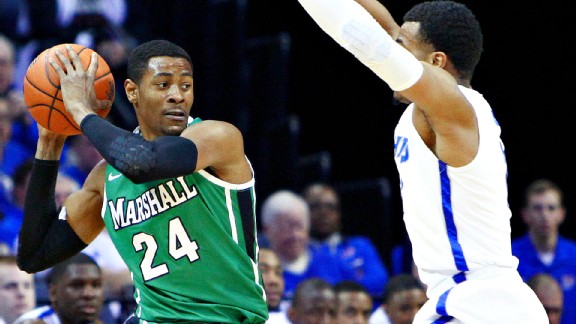
Pittman is a physical specimen that has attracted all coaches at all levels in his playing days. At 6'9, 210 pounds, Pittman has shooting ability to play both guard and forward on the wing, and though his dribbling isn't the strongest aspect of his game, it is good enough to merit playing time at the shooting guard position.
While his physical skills have never been in question, it's Pittman's maturity and questionable decision making that has held him back as a player. In junior college, he was dismissed from the Chipola Junior College in Texas in April due to multiple arrests. In October of his first season at Marshall University in 2012, he was involved in an altercation with a male Marshall student where Pittman faced misdemeanor battery charges (he later made a plea agreement). After eight games at Marshall his senior season (last year), the Thundering Herd suspended him indefinitely and he decided to leave the team after the suspension to pursue a professional career (more on that below). Off the court, Pittman hasn't done much right.
But on the court, Pittman has produced, especially at Marshall. His junior year was extremely promising as evidenced by his comprehensive stats courtesy of DraftExpress. Take a look at his per 40 stats in his two seasons with Marshall:

And then take a look at his efficiency stats in his first year at Marshall:

In his junior year, Pittman produced a PER (player efficiency rating) of 20.1. In the 8-game sample his senior year, he was on his way to surpass that with a 26.6 PER. His usage rate increased from 22.6 his junior year to 32.2 his senior year, and it was obvious that Pittman was turning into a reliable, go-to-guy for the Herd. He had three 30-plus scoring games in his eight game sample his senior year before his suspension, though they did come against pretty inferior competition (South Carolina State, Morehead State and UNC Wilmington). But regardless of competition, it is interesting to see if Pittman could have turned into a premiere player in the Conference USA judging by his impact and usage his senior season with the Herd.
So how did Pittman get to the D-League?
After Pittman was suspended, it seemed like Pittman had run out of chances at the collegiate level. Considering his past legal and off-the-court issues, it seemed very unlikely he was going to get back with the team and transferring didn't seem like an option for it was unlikely he was going to get another chance with another college, let alone another Division 1 school. So, much like Glen Rice Jr. the year before (who was dismissed from Georgia Tech), Pittman left Marshall and decided to go the D-League route to prepare for the NBA Draft.
In a good profile with Mid-Major Madness, Pittman acknowledged his mistakes and vowed that he has changed for the better. Here are some comments about the changes he made personally in his life and his drive in preparation for the draft:
"I’ve spent a lot of time handing out food for the homeless," said Pittman. "I also helped administer used clothes to the homeless with Kroger grocery stores. But other than that, I eat, sleep and drink basketball. I want coaches to know that I’m as hard working and humble as anyone else. I want an opportunity in the NBA more than anything, and to prove people wrong and that I am cut out for this."
The 87ers, who have been more than willing to take a flier on guys with checkered histories (see Carr and Norvel Pelle), ended up signing Pittman, hoping that his new outlook and the experience from the problems had changed him for good. Though he only played 10 games and averaged 20.6 minutes per game, Pittman stayed out of the media when it came to off-the-court issues, which is a success for him considering how bad his reputation was prior to signing with Delaware.
So how did Pittman do in the D-League?
Pittman didn't replicate his college production, but that was to be expected. The 22-year-old wing was a late addition, and considering how poor Delaware played this season (they finished 12-38), I'm sure trying to fit into the 87er squad wasn't an easy endeavor. The lack of experience with the team and his struggle to find a rhythm at a much higher level of play had the most effect on his efficiency, as his PER dipped to 12.7 and his TS % hovered around 54% according to DraftExpress, and his PIE (Player Impact) was 5.8%, according to the D-League stats page.
But considering his experience and his late exposure to the team, Pittman certainly held his own. He averaged 10 points per game and 3.6 rebounds per game in the 10 game sample and continued to show many of the skills that made him such an enticing prospect. For starters, Pittman's outside shooting carried over at the D-League level in some regards, as he proved to be a solid catch and shoot player. 66.7 percent of his 3 point shots came unassisted, and 33.8% of his points came from beyond the arc in his time with the 87ers. Pittman shows good shot form, with a high arc and clean release, and with his size, it makes it difficult for smaller wing or perimeter players to contest it. Let's take a look at Pittman's shot chart for the year, and pay specific attention to where he made most of his 3-point shots:

Pittman proved to be very efficient from the corner, especially from the right side. Considering how NBA teams like to spread the ball around and find those shooters in the corner for the 3 (heck, just look at the Spurs and Heat), Pittman could prove himself to be valuable to many different NBA squads. How he progresses with this outside shot and dependable he can be with it could be the difference from him finding a spot in a NBA rotation or being a Minor League lifer who spends a majority of his professional career in the D-League or overseas.
Though his outside shooting has garnered a lot of praise, Pittman has also showed a strong ability to dribble drive and finish around the rim. Here's a possession in a D-League game where he recognizes the advantage in the matchup and finishes successfully around the rim.

Pittman (located in the right wing around the score ticker) makes a good crossover move on the wing defender, recognizing the space open in his area, which is prime for him to dribble drive into. The BayHawks are throwing some kind of zone look with the post defender manning the middle sagging heavily off his man at the top. From here, it really depends on Pittman's skills and athleticism in terms of how this possession will finish. If he is athletic and strong in his drive, he'll get the bucket or fouled. If he isn't, it could result in a turnover or blocked shot.
Let's see how it finishes:

He successfully drives by the wing defender and as expected, the post defender helps and picks him up. Pittman however continues to attack, seeing the middle of the lane open and knows to be aggressive. At his size, he can hold his own with both post defenders (look at the other defender lurking on the left block), but he has the athleticism and speed to drive by them as well. Which results in ...

This excellent finish at the rim. Not only does he get by the slower post defender, but Pittman sidesteps and finishes on the right side, knowing that the help is coming from the left block. And thus, the post defender on the right block can't defend it because he can't match his athleticism, and the right block defender just is too late in terms of helping, unable to defend due to Pittman's adjustment. It's this kind of ability to recognize the defense and finish appropriately that makes Pittman a special player. And if you look at the shot chart above, Pittman was very reliable around the rim, as he was above league average at 63.3 percent. Check out the highlight video below and you'll see Pittman doing much of the same things on tape.
If Pittman has any weaknesses, it may be the fact that his game isn't very diverse beyond scoring. He isn't as strong a rebounder as you would imagine considering his size. He only averaged 0.9 offensive rebounds per game with Delaware, and his rate was 5.1 percent his junior season as well (5.0 percent in the smaller senior season sample). In order to take advantage of his size and ability to score around the rim, he has to be more active in terms of getting loose balls and second chance points (only 1.9 second chance points average last year). Also, defensively, while he has the length and size to affect opposing wing players, he doesn't show as much commitment or consistent energy on the defensive end of the ball. While that is something that can improve (after all, he has the natural gifts to be a better defensive player), it is something he needs to be aware of going forward if he wants to stick on a NBA roster.
While Carr may be a genuine longshot, Pittman has more of a punchers chance to get selected in the second round. While the odds are long, it is obvious he has the skills, size and athleticism to compete for a NBA roster spot. He showed immense promise not only in his time at Marshall, but in his short stint with Delaware, especially when you consider the situation he was going into (late in the year, losing team, etc.). Of course, his off court issues will definitely hurt him in this draft, and could be one of the big reasons why he could go undrafted next Thursday. Fellow Thundering Herd alum Hassan Whiteside had many similar "character issues" despite being a first round talent, and those issues eventually led to him being out of the league and bouncing from overseas team to overseas team currently (he was recently released by a Lebanese professional team) despite his skills and size. I think Pittman is a lot more mature than Whiteside was entering the draft (after all, Pittman has experienced a lot more "consequences" in comparison to Whiteside), but it wouldn't be surprising to see NBA front office members hold the Whiteside flame out against him due to them both being from Marshall and both having a history of character issues. It may be unfair, but that's kind of how things go when it comes to evaluating players to draft sometimes.
Whether he is drafted or not (my guess is no), it'll be interesting to see his progression next year as a full-time professional. Even if he makes it back to the D-League next year, he certainly is the kind of player who could make an impact with a D-League team immediately. And, starting the year with the squad would help him a lot more in terms of finding his role, and thus improve his stock and reputation even more in terms of making a NBA roster. It would not be surprising at all if we are hearing about Pittman again some point next December or January, eligible for a callup and 10-day contract.
